My new blog can be found here:
http://lostincelluloid.wordpress.com/
I'll be carrying on exactly the same as before there, only hopefully better.
Monday, 14 January 2013

Sunday, 13 January 2013
An Important Notice
As of tonight, this blog will no longer be in use. I've become a traitor and decamped to Wordpress. By tomorrow it should be up and running and I'll post the link to it on here. There will be a shiny Les Miserables review waiting for you.
Thanks for reading, and please don't stop.
Thanks for reading, and please don't stop.
Wednesday, 2 January 2013
Top Twenty of 2012
Christmas is going, the geese are presumably losing weight and it's the end of another year. Which means it's time for me to cast my eye back over the year in film and pick out twenty of my favourites.
But first, a New Years Resolution
Over the past few months, several (okay, about three) people have asked me what happened to this blog, and even told me to start writing again. Unfortunately over the last semester I was swamped by university work and ran out of time for blogging. I want to apologise for anyone who feels they've been unable to attend the cinema without my guidance (indulge me) and I promise I will be back to wasting my life writing about things I've seen on a screen very shortly. We're heading into awards season now, so I'll have plenty to chew one. Sorry for the absence, and thanks for reading.
And now back to the list...
A few disclaimers:

But first, a New Years Resolution
Over the past few months, several (okay, about three) people have asked me what happened to this blog, and even told me to start writing again. Unfortunately over the last semester I was swamped by university work and ran out of time for blogging. I want to apologise for anyone who feels they've been unable to attend the cinema without my guidance (indulge me) and I promise I will be back to wasting my life writing about things I've seen on a screen very shortly. We're heading into awards season now, so I'll have plenty to chew one. Sorry for the absence, and thanks for reading.
And now back to the list...
A few disclaimers:
- This is not an attempt to make a definitive 'Best of the Year' list. Neither is it entirely down to personal preference. Instead it is an attempt to bridge those two, although it ended up being a completely arbitrary list of films that tumbled into an order that looked about right.
- All entries are based on UK release date.
- I tried hard to catch up with as much as possible, but here are a few films that I wasn't able to see in time to be considered: Argo, Rust & Bone, The Grey, Tabu, 5 Broken Cameras, The Innkeepers, This Is Not a Film, Silver Linings Playbook, Goodbye First Love, Life of Pi, Room 237
20. Into The Abyss- The year wouldn't
be complete without anything from Werner Herzog. His documentary on
the American death penalty found time for small moments of humanity
and compassion while still tackling the big questions of what drives
a person, and indeed a state, to kill. Although the sense that he's
preaching to the choir makes this something of a lesser Herzog film,
he makes clear his objection to the death penalty early on and
remains objective throughout.
19. Magic Mike- One of the most
unexpected surprises of the year came from Steven Soderbergh's ageing
male-stripper drama that took its cake, then decided to eat it
anyway. It's an exploitation film that doesn't exploit and a film
with morals that doesn't moralise. Soderbergh never once seems to be
excusing his subject matter, and it's the sort of film where a group
of male strippers sit on a beach discussing share prices and the
economy.
18. Hara-Kiri: Death of a Samurai- Takashi Miike has
never been a director know for his restraint, which makes this slow
burning remake of a Japanese classic (which I'll confess to never
having seen) all the more surprising. It's an elegantly bleak peeling
back of the Samurai myth to reveal the gangrenous flesh beneath. If
there's a problem, it's that after the ominous opening, the middle is
so restrained that it almost grinds to a halt, but it finds its feet
again for a stunning finale.


Hara-Kiri: Death of a Samurai
17. Cosmopolis- A surprisingly low showing for
Cosmopolis, given my love for David Cronenberg and my endless gushing
about it after leaving the cinema. Perhaps in hindsight it's a little
too cold for its own good, lacking in re-watchability. Still, it's an
intelligent and razor sharp offering from the Canadian auteur, and it
proves there's more to Robert Pattinson than sparkly vampires.
16. The Hunt- Thomas Vinterberg mainly has old ideas
to put forward in his tale of an innocent man accused of child abuse,
but he screams them with a forceful sincerity that's impossible to
fault. It's a disturbingly timely release, and the magnificently
downtrodden central performance from Mad Mikkelsen takes you into the
heart of a community gripped by hysteria.


The Hunt
15. Skyfall- Skyfall seems to
contain all the usual building blocks of a Bond film, but they're
carefully slid into place to show off their unexplored angles in one
of the most solidly enjoyable entries in the entire franchise. Maybe
it's goodwill after the awful Quantum of Solace, the foregrounding of
the formidable Judi Dench, or the titanic presence of a scenery
chewing Javier Bardem. Even the usually portentous Sam Mendes seems
to be enjoying himself as he blows the cobwebs off a creaky old
skeleton of a franchise, and it's hard not to share in his enthusiasm.
14. Killer Joe- 2012 marked the
resurgence of Matthew Mcconaughey, and nowhere was he better than as
the title character in William Friedkin's Southern-fried noir. His
blood-freezing performance gave an icy core to the swampy waters of
the rest of the film, but less obvious is the brilliant Juno Temple.
It does for fried chicken what Reservoir Dogs did for Stuck In the
Middle With You.


Killer Joe
13. Berberian Sound Studio- Toby Jones remains one of the most dependable character actors working today, and it's
his solid presence that holds Peter Strickland's not-quite-horror
down where otherwise it might blow away. It's a magnificently creepy
film about the insidious possibilities of sound, but it has a third
act that goes up one gear too many. Strickland pogos head first off
the diving board of narrative sense, but overshoots his mark and ends
up further out in uncharted waters than he probably intended.
12. Beasts of the Southern Wild- It falls short of the poetic masterpiece status thrust upon it at it's festival showings, but this debut from Benh Zeitlin is still packed with a creativity and imagination that's hard to fault. Its amateur cast rise to the challenge admirably, with the impossibly young Quvenzhané Wallis proving to be a miniature force of nature. Its reach ultimately exceeds its grasp, but its ambition is admirable.
12. Beasts of the Southern Wild- It falls short of the poetic masterpiece status thrust upon it at it's festival showings, but this debut from Benh Zeitlin is still packed with a creativity and imagination that's hard to fault. Its amateur cast rise to the challenge admirably, with the impossibly young Quvenzhané Wallis proving to be a miniature force of nature. Its reach ultimately exceeds its grasp, but its ambition is admirable.
11. Marth Marcy May Marlene- Of all the films I
was forced to leave out of my top ten, this was the most
heartbreaking decision. But in the end, it had to be done, even if it
is a beautifully constructed horror story of shifting identities, and
the central performance by Elizabeth Olsen is one of the year's very
best. Take it then not as a failure for this film, but as a testament
to just how good a year 2012 really was.
10. The Cabin in The Woods- There's no
shortage of writers and directors trying to be the new wild child of
cinema. Drew Goddard and Joss Whedon seem content to be Hollywood's
resident smart-arses. The Cabin in the Woods is at once a loving
tribute and a parentally concerned satire of horror that pokes around
in its very mechanics with a pair of rusty, blood-stained tweezers.
It is also, quite possibly, the funniest film I saw all year, and
features the finest use of a unicorn ever.
9. Sightseers- There's something sick at the heart of
Britain in this perfect storm from director Ben Wheatley and
stars/writers Steve Oram and Alice Lowe as the couple on a caravan
killing spree. Like Mike Leigh making Video Nasties, it's a delicate
balancing act between icy black humour, mean spirited horror and some
delicate social commentary. It's a testament to the three main
talents that it never once falters. It doesn't have the sheer
disarming weirdness of Wheatley's Kill List, but it will ensure that
you never hear The Power of Love in quite the same way again.

8. The Imposter- 2012 was a brilliant year for documentaries, and few were finer than Bart Layton's The Imposter. Its 'so mad it must be true' story sees the missing child of an American family miraculously returned to them, albeit the wrong age, hair colour and with a French accent. Could it be that he's not who he says he is? (Hint: he isn't) It could be a film about the fluidity of identity or the elusivity of truth, but mostly its worth the watch for the moments where you wonder if it's all a hoax.
7. Once Upon a Time in Anatolia- Once again we find ourselves watching a search for the truth. This time it's a long dark night of the soul as a group of police, a doctor, a prosecutor and a murder suspect search aimlessly for a body on the Anatolian steppe. Unfolding at a languorous pace, we slowly come to learn more about these disparate characters, and that all of them hold their own secrets. It's the kind of film you can watch over and over again, picking up new layers of meaning from the tiniest of nuances every single time. Even now I'm wondering if it should be slightly higher. Perhaps time will see it slowly creeping past the next few titles.

The Imposter
8. The Imposter- 2012 was a brilliant year for documentaries, and few were finer than Bart Layton's The Imposter. Its 'so mad it must be true' story sees the missing child of an American family miraculously returned to them, albeit the wrong age, hair colour and with a French accent. Could it be that he's not who he says he is? (Hint: he isn't) It could be a film about the fluidity of identity or the elusivity of truth, but mostly its worth the watch for the moments where you wonder if it's all a hoax.
7. Once Upon a Time in Anatolia- Once again we find ourselves watching a search for the truth. This time it's a long dark night of the soul as a group of police, a doctor, a prosecutor and a murder suspect search aimlessly for a body on the Anatolian steppe. Unfolding at a languorous pace, we slowly come to learn more about these disparate characters, and that all of them hold their own secrets. It's the kind of film you can watch over and over again, picking up new layers of meaning from the tiniest of nuances every single time. Even now I'm wondering if it should be slightly higher. Perhaps time will see it slowly creeping past the next few titles.
6. Searching for Sugarman- It seems that all the best
documentaries this year were concerned with finding the truth.
Searching for Sugarman was about the search for the truth behind the
myth of Sixto Rodriquez; an American singer from the 60s who faded
into obscurity everywhere except South Africa. There he became a hero
to anti-apartheid liberals, who assumed he was as big as Dylan or The
Beatles in America. It's a powerful and uplifting exploration of the
necessary building of a myth, and it will introduce you to the poetic
protest-folk of Rodriguez himself.
5. The Raid- Some films make you consider the
infinite possibilities of life, the universe and everything. And then
there are some where people get their heads smashed to a pulp and
their shins kicked into splinters. The Raid is one of the finest,
most blood-splatteringly violent action movies I have ever seen. The
feats of physicality are more impressive than a dozen histrionic
Oscar-bait performances and director Gareth Evans puts Hollywood to
shame with his demonstration of the way great action should
be shot. Perhaps the best praise I can give to The Raid is that I can
imagine it still being passed around by word of mouth many years from
now.


The Raid
4. Amour- The title is in no way ironic. Haneke may have spent his career lambasting bourgeois complacency, but this is a painfully frank and honest depiction of love in the twilight of life. It helps that the performances by Jean-Louis Trintignant and Emmanuelle Riva are so rounded and beautifully understated. But its refusal to look away from their suffering makes it a hard film to watch. A perfect film then, a beautiful one and a truly great one. But I don't think I can ever watch it again.
3. Moonrise Kingdom- No one could ever
doubt Wes Anderson's formal brilliance or his off-kilter humour, but
with Moonrise Kingdom he finally found what he seemed to have lost: a
heart. He clearly cares about his lovestruck young runaways just as
much as the adults searching for them, making this his warmest and
funniest dissection of American dysfunction in a long while. An esteemed cast inlcuding Bruce Willis, Edward Norton, Frances McDormand and Tilda Swinton bring their deadpan best, but this is a film that belongs to its child stars. There's no smugness of precociousness here, just brilliant performances and rounded characters trying to find there place in a world of skewed wonders. Is it a better film than Amour? No, but this is my personal list, and I say it goes here.


Moonrise Kingdom
Which brings us to the top spot. That's right, after making you read through the whole list I still haven't given you a simple Number 1. I found it impossible to choose between these two, and so here are my joint first films of the year:
1. Holy Motors & The Master

The Master
The Master- I have to confess
first that I'm an unashamed, card carrying member of the cult of Paul
Thomas Anderson. He's one of the bravest filmmakers working today,
continuously casting off the shackles of his influences as he expands
upon his own mercurial vision. With The Master, he continues forward
on the journey into America's heart of darkness that he began with
There Will Be Blood. This is a post-war America of shattered lives
and aimless souls, bathed in the glow of stunning cinematography as
they desperately search for meaning and for the comfort of the past.
It features three of the year's best performances from Joaquin
Phoenix, Philip Seymour Hoffman and Amy Adams, but it's as much a
triumph for Anderson himself. He's assembled it in an almost collage
manner, free-wheeling between disconnected scenes of character study.
I fully understand why this put so many people off, but personally
I'd be happy to sit through every second that Anderson shot.


Holy Motors
Holy Motors- What can I tell
you about Leos Carax' Holy Motors? That it's a kaleidoscopic,
surreal, pyschogenic fugue of myriad meanings? All that is true, but
it would only serve to make it sound horribly portentous, and to make
you stop reading. It would fail to take into account just how
enjoyable, how funny and how full of life Holy Motors really is. The
extraordinary Denis Lavant plays Oscar, an enigmatic man ferried
around Paris in a limousine, adopting a series of disguises for his
increasingly surreal encounters. It is strange and it might well be
meaningful, but it also has a gleeful wit and brio as it pinballs
from one bizarre scenario to another. Perhaps we're supposed to read
meaning into this jumble. Or perhaps we're supposed to sit back and
enjoy the ride as Oscar becomes a mad vagrant, a disapproving father,
a violent thug, a smooth businessman. It's cinematic spectacle
without the restraint that comes with making sense, and it's all the
better for it. Oscar tells us this himself, when asked what makes him
continue: “What made me start”, he replies “the beauty of the
act.”
Saturday, 17 November 2012
The Master (2012)

The Master is not a film about
Scientology. It is neither the cult expose or the thinly veiled L.
Ron Hubbard biopic that so many were expecting back when it was first
announced. Instead it sees director Paul Thomas Anderson returning to
the marginal lives and restless souls of his 1997 breakthrough Boogie
Nights. Joaquin Phoenix plays Freddie Quell, a WWII veteran and
deeply troubled alcoholic drifter who finds himself drawn to
writer Lancaster Dodd and his faith based movement The
Cause. If There Will Be Blood was a dark fable of the men who built
America on a foundation of greed and brutality, then The Master is
about the attempts to reassemble it in a shattered, post-war world.
Anderson abandons conventional
narrative almost completely in favour of character drama as Dodd's
creation grows and he attempts to locate and heal the source of
Freddie's unrest. As the ambiguously intentioned Dodd, Philip Seymour
Hoffman reassures everyone that he's still one of the finest actors
of his generation, his charmingly arrogant demeanour and explosions
of startling rage a mixture of Hubbard and Orson Welles. One of the
film's biggest surprises is his steely wife Peggy, played entirely
against type by a Machiavellian Amy Adams. The implication that she
is the real mastermind behind The Cause is one of the film's many
avenues left tantalisingly unexplored.
Nobody is anything less than perfect,
but Phoenix is beyond extraordinary. Freddie is a fascinating
creation, demanding and deserving of comparisons to the great
outsiders of cinema; to the likes of Travis Bickle, Randle McMurphy
and Jim Stark. It's a performance of both jaw-dropping magnitude and
heartbreaking subtlety. Phoenix's entire body is bent out of shape,
and his remarkable face is twisted into a permanent mask of
inscrutable pain and regret. Whenever his anger bursts out in acts of
physical violence, as it often does, it's easy to believe that
Anderson simply set Phoenix loose and pointed a camera at the ensuing
chaos. No matter how the rest of The Master fares with audiences,
critics or awards ceremonies, I have little doubt that Phoenix's
performance will go down as a truly great one.
These characters dominate the screen,
and Anderson gives them suitable scenery to chew. The cinematography is without a doubt the most breathtakingly stunning that you will see all year, and the period detail is beyond reproach. It is set in a perfectly recreated world, and yet it may as well take place on Mars. There's a surreal, disconnected feel to this world that is as unrecognisable and dreamlike as Freddie's hazy recollections of his past. How much of this is his memories? How much of it is even real? Anderson isn't telling.
It's hard not to admire the bravery of Anderson's technique. In many ways he has become the anti-Quentin Tarantino. Whereas the once great Tarantino has retreated further into his fortress of movie geek references with every film, Anderson has shot off the rails of conventional cinema completely and is now ploughing his own trail through uncharted territory. Undoubtedly brave, but certainly not something that will impress everyone.
It's hard not to admire the bravery of Anderson's technique. In many ways he has become the anti-Quentin Tarantino. Whereas the once great Tarantino has retreated further into his fortress of movie geek references with every film, Anderson has shot off the rails of conventional cinema completely and is now ploughing his own trail through uncharted territory. Undoubtedly brave, but certainly not something that will impress everyone.
Whether you like the film or not will
depend entirely on your response to its endless hall of mirrors
approach. It is an ideal film for debate, but certainly not one that
all will find engaging. It's a defiantly unfathomable work, shot
through with a deep core of sadness. But ultimately it is a film
about two men: one whose arrogance and brilliance birth something
that grows far beyond his control, and one broken beyond repair.
Freddie is a man in thrall to the search for his very own Rosebud; a
past that may never have existed and that can never be reclaimed.
Monday, 3 September 2012
Berberian Sound Studio (2012)
.jpg)
Rupert
Brooke famously wrote that there is “some
corner of a foreign field that is for ever England”. It's a
sentiment that seems particularly fitting for Toby Jones in Peter
Strickland's not-quite-horror Berberian Sound Studio. Jones is
Gilderoy, a man whose tweed suits and maladroit demeanour are the
walking, breathing embodiment of Dorking. He's a sound engineer for
pastoral nature documentaries who has been brought to the dimly lit
studios of an Italian horror studio to provide the sounds for a
giallo: the kind of glossy, gory pulp chillers perfected by Dario
Argento in the 1970s. Tasked with aurally recreating the sadistic,
sexually explicit violence of a trashy horror and surrounded by
bullish producer Francesco and sleazy studio head Santini, Gilderoy
attempts to immerse himself in his work, unable or unwilling to
realise that his ordered world is falling apart.
Strickland's
film is never quite a horror film. We are never shown the horrific
footage that Gilderoy is providing the soundtrack for. Instead the
film seems more interested in the sounds of horror; or perhaps more
accurately, the horrors of sound. The hermetically sealed world of
the sound studio, where no scream or stabbing sound effect can be
escaped, drips with a very palpable malevolence, like a dial and wire
filled room of The Shining's Overlook Hotel. Much has been made of
the film's similarities to the work of Lynch or Bergman, and while
it's true that it shares Mulholland Dr's sense of unspeakable dread
and Persona's shifting identities, what is most impressive is that
Berberian Sound Studio seems always to be its own beast. Strickland
has learnt his lessons from these film makers without ever relying on
their formulas. Some have complained about the lack of a definitive
third act, but for the movie to increase gears in its final third
would be to drag it too far into territory derivative of film makers
like Lynch. Berberian Sound Studios takes it's time. It is patient,
it waits, and it ends when it wants to end. Anything else would be
cheapening.
Without
anything to hold the movie down, it would be easy for it to get
carried away with its own cleverness. Fortunately Toby Jones provides
just such an anchor. Jones is surely one of the best character actors
working, and here he gives what may be the performance of his career.
Like Gene Hackman in The Conversation, Gilderoy tries to escape into
a world of sound as he descends further into paranoia. Never could a
fish be more out of water, and Strickland even rings several moments
of brilliantly icy black humour out of his predicament. His pudgy,
crumpled face moves through an entire spectrum of emotions with the
movement of an eyeball or a twitch of a muscle. Strickland gives us
many reasons to admire Berberian Sound Studio, but Jones gives us a
reason to care. Together they have created one of the most
distinctive, bold and memorable films of the year.
I'm back
I took a break from the blog over the summer, but now I intend to start writing again. Bear with me, it may take a while to get back into the habit.
Joe.
Tuesday, 19 June 2012
Cosmopolis (2012)

Cosmopolis must surely rank as one of
the slowest road movies ever made. It follows the gradual crawl of a
white limousine as it moves from one side of Manhattan to the other.
Inside is Eric Packer (Robert Pattinson), an insanely rich and
staggeringly young billionaire who simply wants a haircut. Packer is
the pinnacle of the ultra-rich 1%, one of Tom Wolfe's self styled
Masters of the Universe; in this case, a portable, self contained
universe. We see Packer's self engineered financial and personal
downfall as he is ferried ever closer to a climactic confrontation
with Unabomber-like former employee Benno Levin (Paul Giamatti), the
nadir of the other 99%.
In terms of it's place in the oeuvre of
director David Cronenberg, the easiest and most obvious connections
would be with his other automotive nightmare, Crash. Both films
create a glacial, hermetically sealed world, but whereas Crash allows
us to peer in at this world through the glass, Cosmopolis places us
inside of it. The interior of Packer's limo, bathed in the blue light
of the screens bringing him news of his financial destruction, is
scarily silent. Whenever the door is opened, the sounds of the city
are almost deafening. His succession of advisers and analysts all
speak in stilted sentences and strangely hollow sound bites, Samantha
Morton in particular being disarmingly blank and angular as Packer's
personal theoretician. As the cold and vulpine Packer, Pattinson
undoubtedly has the hardest job, being on screen for almost every
second of the movie, but he adds further proof of Cronenberg's canny
eye for casting. He plays Packer as someone who has done too much,
too young, and has nothing left but the thrill of losing it all. When
we first see him holding court in his limo, he's dwarfed by his
throne like chair. And when he exits the limo to confront an
attacker, a gun tucked into his trousers, he does so with the cocky
strut of a schoolboy trying to act harder than he feels. It's a pitch
perfect performance that proves there is more to Pattinson than an
army of screaming and swooning fans.
Paul Giamatti, on the other hand, has
nothing to prove. The final twenty minutes of the movie, where Packer
finally exits his universe and enters that of Giamatti's balding,
dishevelled Levin, are the real triumph of Cosmopolis. The likes of
Levin, those who have fallen through the cracks, have no place in
Packer's world; “Do you think people like me can't happen?” Levin
demands. He's the abandoned chickens of rampant capitalism come home
to roost, desperation in his eyes and a gun in his hand. It's a gold
standard of naturalistic scenery chewing, and armed with Cronenberg's
style and Don DeLillo's words, he doesn't put a foot wrong.
Those looking for grand, damning
statements on the evils of capitalism may not find Cosmopolis
entirely satisfactory. Cronenberg seems more interested in showing
modern society stretched to breaking point, threatening to snap at
any moment. It's an incredibly easy film to admire, and an extremely
hard one to love. It's certainly not a film for everyone, but then
there's no fun in films that aim to be for everyone, and by extension
are for no one. Cosmopolis is a film for some, and on those grounds
it is almost flawless. And that's just fine by me.
Monday, 11 June 2012
Prometheus (2012)

Prometheus
is not Alien. It seems necessary to make this clear. In fact,
thematically it bears more relation to Ridley Scott's own Blade
Runner. Both films ask what it means to be human. Blade Runner asks
these questions indirectly, and even comes close to giving answers;
Prometheus goes straight ahead and asks the questions, then never
fully answers them. In this case, they are raised by a team of
scientists travelling to a distant planet to find the beings
responsible for life on Earth. The name of their ship is Prometheus,
and the implications are clear: you don't mess with the gods. Whether
or not you like the film will probably depend on how much you care
about it's lack of satisfying answers.
Speaking
for myself, I have no problem with remaining mystified. Too many films are
lacking a sense of awe and mystery, and in several key scenes Prometheus delivers just this. The breathtaking design of the film alone is worth the price
of admission; it has to be the most visually beautiful film I've seen
all year. The problem lies with it's failure to succeed on a human level. The embarrassingly weak script and a disjointed story struggle against a strong cast who have to work hard to keep us interested.
Noomi Rapace is a strong leading presence in her first English speaking lead role, with
Scott opting for more than a simple
Ripley re-tread. Her unshaken religious faith, even in the face of
possible answers to life's great questions, is surprisingly original
and refreshing. She's helped by a solid supporting cast, but even
their combined strengths are overshadowed by the presence of Michael
Fassbender. His performance as David, the ship's android, has been
receiving so much acclaim that praising him has almost become a
cliché. It's justified however, and in many ways David is the
central crux of the movie, providing the same function as Rutger
Hauer's Roy Batty in Blade Runner. They both share an Aryan
flawlessness that manifests as veiled contempt of the humans around
them, as well as a vague yearning to be as 'human' as them. There is
a nice touch as David is seen modelling his appearance and speech
pattern on Peter O'Toole in Lawrence of Arabia. Later he offers a
quote from that film to hint at the futility of the mission: “There
is nothing in the desert, and no man needs nothing”.
Ultimately,
Prometheus doesn't hold together. It's fails to come as close as
Blade Runner to answering any of it's central questions, and to
describe the plot and script as messy would be far too kind. It is so staggeringly ambitious that it's
failure to succeed is almost inevitable. It never works as a whole, but there are several moments when it soars.
Friday, 18 May 2012
Reviews in a Nutshell
As I've mentioned, I'm right in the middle of my exams and so haven't
been able to write full reviews for the films I have seen recently.
Instead, here's a very quick run through, in the order that I saw them:
The Pirates! In an Adventure With Scientists- As charming and witty as you would expect from Aardman, if not their most memorable.
The Cabin In The Woods- Rarely have I had this much fun in the cinema. A smart satire made by people who love the genre, and a lot more enjoyable than the similarly self-referential Funny Games (which I hate).
The Avengers- less than the sum of it's parts, but brilliantly enjoyable and funny while you're watching it.
Jeff, Who Lives At Home- Sweet, warm and funny, but ultimately rather forgettable.
The Raid- If I see a more brilliantly thrilling, hyper-violent film all year, I'll be mightily impressed. I'll also be surprised if it doesn't sneak into my top ten of the year.
Instead, here's a very quick run through, in the order that I saw them:
The Pirates! In an Adventure With Scientists- As charming and witty as you would expect from Aardman, if not their most memorable.
The Cabin In The Woods- Rarely have I had this much fun in the cinema. A smart satire made by people who love the genre, and a lot more enjoyable than the similarly self-referential Funny Games (which I hate).
The Avengers- less than the sum of it's parts, but brilliantly enjoyable and funny while you're watching it.
Jeff, Who Lives At Home- Sweet, warm and funny, but ultimately rather forgettable.
The Raid- If I see a more brilliantly thrilling, hyper-violent film all year, I'll be mightily impressed. I'll also be surprised if it doesn't sneak into my top ten of the year.
Monday, 7 May 2012
Apologies...
... for the lack of posts recently, but I'm right in the middle of my exam period.
I've tried to find time for reviews of Avengers Assemble, Cabin in the Woods, The Pirates! and Jeff, Who Lives At Home, but you try writing reviews when you have Illuminations by Walter Benjamin breathing down your neck.
Once they're out of the way I shall be back to wasting my free time with this blog. Never fear.
Joe.
I've tried to find time for reviews of Avengers Assemble, Cabin in the Woods, The Pirates! and Jeff, Who Lives At Home, but you try writing reviews when you have Illuminations by Walter Benjamin breathing down your neck.
Once they're out of the way I shall be back to wasting my free time with this blog. Never fear.
Joe.
Friday, 16 March 2012
The Raven (2012)
*A bit short, but I was working to a word limit*
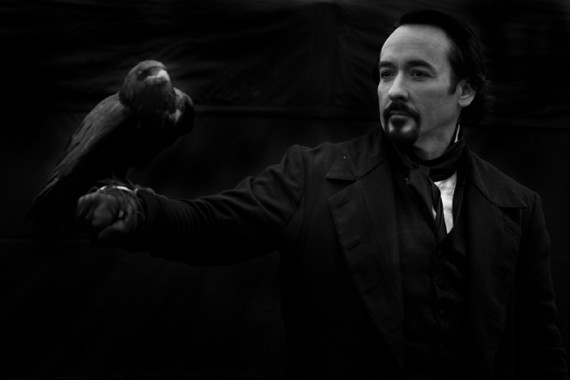
The spectre of Guy Ritchie's surprisingly and embarrasingly enjoyable Sherlock Holmes films looms large over James McTeigue's fantastical take on the last five days of Edgar Allen Poe like... well, a raven. Although it nicely imitates the classic Hammer meets steampunk look Ritchie's films established, The Raven forgets to borrow any of the former's self-awareness and slightly mocking humour. It remains po-faced long after it should have cracked a smile. For such a ludicrous premise, it's stony faced attempt at gravitas is pretty much unforgivable, especially as it's about a writer with an infamous acid wit and macabre sense of humour.
Even John Cusack, an effortlessly likeable actor capable of wading through the very worst movies with his dignity intact, can't save this film; although he tries his very hardest. His Poe is suitably ragged, washed up and prone to violent outbursts, but even this isn't enough to stop the deluge of vacuous heavy-handedness that McTeigue brings to the table. There's nothing here that couldn't be seen, but done far more effectively, with a double bill of Se7en and Roger Corman's Pit and the Pendulum. Save yourself a trip to the cinema, and just watch those two instead.
Saturday, 25 February 2012
The Oscars 2012: Predictions
Hollywood's annual shameless back slapping is nearly with us again, so for several of the major categories, I've gone through and suggested who I think will win, who from the nominees I think should win and who should have been nominated. Feel free to come back on Monday morning and tell me how wrong I was:
Best Picture
Will win: The Artist. I just can't see it being anything else
Should win: Tricky. It's a fairly patchy category this year, and The Artist was a magnificent film, but my personal favourite was Hugo.
Should have been there: Drive, Tinker Tailor Soldier Spy and We Need To Talk About Kevin are the three that spring to mind. I'm sure that room could also have been made for Shame. Martha Marcy May Marlene was also a brilliant film, but it's a million miles removed from a typical Oscar nominee. If they got rid of the patronising foreign language category, A Separation would also have been a must, and The Skin I Live In would have been a brave choice. As it stands, the category is something of a stinker.
Best Director
Will win: Michel Hazanavicius
Should win: Although the film itself was an admirable but massively flawed mess, I'm going to go with Terrence Malick.
Should have been there: Lynne Ramsay and Nicolas Winding Refn. Would have been nice to see Pedro Almodovar and Tomas Alfredson in there too.
Best Actress
Will win: A hard one to call. Meryl Streep's momentum seems to finally be burning out, and Viola Davis is seeming ever more likely.
Should win: Again, it's hard to judge, as it's not a particularly strong category and I haven't seen Albert Nobbs yet, although I've heard that Glenn Close is very good. Anyone other than Meryl Streep, then.
Should have been there: Olivia Colman, for giving one of the best performances of any actor or actress all year. Leaving out Tilda Swinton was unforgivable too, and Elizabeth Olsen should have been in with a chance for Martha Marcy etc. Also, Charlize Theron was magnificently bitchy in Young Adult. Basically I'd replace all the nominees.
Best Actor
Will win: Dujardin seems to have confidently emerged as the frontrunner, and I'd say Clooney is snapping at his heels.
Should win: Gary Oldman. Next question
Should have been there: Fassbender for Shame is the first name that springs to mind. In what experts will soon be calling 'The Year of Ryan Gosling' it seems strange that he wasn't nominated for anything. I'd have gone with Drive. Michael Shannon too, for the excellent Take Shelter.
Best Supporting Actress
Will win: Octavia Spencer
Should win: Hmmm... Berenice Bejo, even though she should really be in the Best Actress category. It's not a great category to be honest. Although apparently Janet McTeer is very good.
Should have been there: Vanessa Redgrave for Coriolanus. Without a doubt. Also, Carey Mulligan for Shame. Jessica Chastain has also been nominated for the wrong film, she was much, much better in Take Shelter than in The Help. And although I hated the movie itself, Charlotte Gainsbourg was as terrific as ever in Melancholia.
Best Supporting Actor
Will win: Christopher Plummer. Somebody could take it from him but I very much doubt it.
Should win: I want to say Max Von Sydow because he's one of my favourite actors, but I just can't justify picking him. Christopher Plummer was great, but I'm going to go with Kenneth Branagh, who was outstanding as Laurence Olivier.
Should have been there: Albert Brooks for Drive, and John Hawkes for Martha Marcy etc. Ezra Miller did the seemingly impossible by holding his own against Tilda Swinton, and about the half the cast of Tinker Tailor could safely fit into the list, particularly Benedict Cumberbatch.
Best Foreign Language Film
Will win: A Separation.
Should win: A Separation. There's a couple I haven't seen though, so I can't judge entirely.
Should have been there: The Skin I Live In, La Quottro Volte and Mysteries of Lisbon.
Best Original Screenplay
Will win: The Artist or Midnight in Paris
Should win: A Separation or Margin Call, but I'd be happy with The Artist or Midnight in Paris.
Best Adapted Screenplay
Will win: The Descendants or Tinker Tailor
Should win: Tinker Tailor
Should have been there: Coriolanus, for hacking down one of Shakepeare's most unwieldy plays into something lean and streamlined.
Best Original Score
Will win: The Artist. The music does have to carry most of the film, after all.
Should win: Tinker Tailor
And of course, Man or Muppet is quite rightly going to win Best Original Song.
Saturday, 11 February 2012
The Muppets (2012)

Did puppeteer Jim Henson know, all those years ago, when he first began to develop his surreal felt vaudeville troupe, just how successful, and how beloved they would become? That they would have fans in every walk of life, and from every corner of the globe? One of those fans is Jason Segel, and like any good fan he was distraught with the Muppets' fall from favour in the early 90s. Unlike most fans however, he has starred in several successful comedies, giving him the chance to put his heroes back on our screens. He also plays the part of Gary, a lifelong Muppets fan who, along with his girlfriend Mary (Amy Adams) and his Muppet obsessed and suspiciously felt like brother Walter, travels to LA to tour The Muppet studios and theatre. They find the studios derelict and about to be sold to evil oil tycoon Tex Richman (Chris Cooper, clearly having the time of his life) who secretly plans to demolish them and drill for oil. After tracking down the now lonely and reclusive Kermit in his mansion, they persuade him to track down and reform the old gang to put on one last show and save the theatre.
Above all else, the reason that the new Muppet film works so well is that it has clearly been made by people who love, know, and most importantly, understand The Muppets and their appeal. They have beautifully retained the anarchic, subversive and self referencing humour that shows little regard for logic, narrative conventions or even the laws of physics. Even the celebrity cameos never feel smug or forced, and the songs from Flight of the Conchords' Bret McKenzie are simply superb.
Just as with the Toy Story films however, the bravest decision has been to give the film a real emotional depth. There's a deep and melancholic sadness to much of the film, as the Muppets are forced to battle against the fact that the world has moved on, and that they are seen as relics of a bygone age. When Kermit roams his mansion, gazing longingly at the portraits of his former friends, it seems incredible just how much sadness and loss is conveyed by a green felt puppet. But one of the greatest triumphs of The Muppets has always been that we never see felt puppets. We see fully rounded characters, from the harried Kermit to the perennially optimistic Fozzie Bear, and every step of their journey seems as real as it would with live actors. When Kermit begins a rendition of the original Muppet Movie's 'Rainbow Connection' and is joined onstage by the rest of the Muppets for the song's finale, it's hard not to be moved (or in my case, not to cry). For this has always been the real brilliance of The Muppets: the certain knowledge that even when everything else is looking grey, a song, a dance and a badly cracked joke will always make the world that little bit better.
Thursday, 9 February 2012
Martha Marcy May Marlene (2012)

For someone with enough of an ego to believe that there may actually be people out there who read this blog, what I'm about to say may sound surprising. If you have already decided to see Martha Marcy May Marlene, please stop reading immediately. It's true that often films can be enjoyed more the less you know about them, but with MMMM, as I will call it from now on, it is ideal to enter the cinema with as little idea of possible as to what you are about to see. For anyone still reading, I'll try and give away as little of the plot as possible.
At the very beginning of the film, we see the titular character, played by Elizabeth Olsen (the one it's okay to like) running away from an unusual, but seemingly harmless rural commune and taking refuge with her estranged sister and brother-in-law. Needless to say, nothing is what it seems. Olsen is not the plucky heroine her flight would suggest, and the 'family' she has fled from, led by father figure Patrick (John Hawkes), is not the eccentric but oddly idyllic retreat it may have appeared. For anyone who knows anything about America in the 1960s, faint bells of recognition should be ringing at the idea of a close knit 'family' of misfits and the disenfranchised living in the wilderness, led by a manipulative 'father' and making night time excursions into people's houses.
Considering that this is Sean Durkin's debut, the directing is brilliantly assured and the performances are uniformly magnificent, particularly the fractured Olsen and the horribly sinister Hawkes, unbearably creepy without ever being overstated. Although it may never seem like it, MMMM is at it's core a horror movie, albeit a sparse, enigmatic and intelligent one. Rather than offer the puerile gross outs of Hostel or the cheap bump in the night shtick of Paranormal Activity, MMMM succeeds where so many horrors fail: it slowly creeps under your skin and then stays there long after the credits have rolled.
I hope this has been unhelpful. Just trust me, and see it.
Thursday, 26 January 2012
Coriolanus (2012)
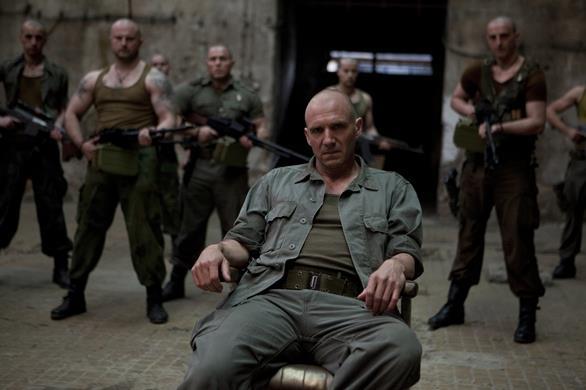
As Ralph Fiennes and Gerard Butler, covered in dirt, sweat and blood, grapple violently on the floor, in a surprisingly similar manner to Alan Bates and Oliver Reed wrestling nude in Women In Love, it should be clear that this is not your standard Shakespeare adaptation. This is the Bard stripped down to barest essentials and shifted to what looks like the modern day Balkans. Coriolanus, about the titular Roman general who is banished and swears revenge against his own people, is renowned as one of Shakespeare's densest and most convoluted plays, and Fiennes deserves praise for not only clarifying the narrative but bringing to the fore themes that make it a surprisingly contemporary film. It's obvious questions about class war, democracy and the nation state make it a fitting film to come at the end of a year of rolling news, increasingly violent protest and the Arab Spring. Even a cameo from Jon Snow, speaking full Shakespearean verse, feels un-gimmicky and strangely appropriate.
Fiennes does a perfectly adequate job behind the camera, making the explosive battle scenes unbearably intense, but he does an exemplary job in front of it. Acting with his entire body, he turns a pitiless, fascistic brute into a scarily charismatic figure; his eyes alone carrying a singular determination that is almost terrifying. Coriolanus is not an easy figure to engage with and Fiennes makes no attempt to soften his disdain and contempt for the masses. He's helped by some stunning support from Jessica Chastain (continuing her quest to be in every single film ever released from now on), Brian Cox and James Nesbitt, and even Gerard Butler turns in a fine performance as Coriolanus' sworn enemy. But casting a shadow over the film is the presence of Vanessa Redgrave as Coriolanus' manipulative mother. She runs away with every single scene she is in and reminds those who needed reminding that when she is on form, no actress on Earth can touch her. It's a towering performance that in any sane world would have seen her name in every single Best Supporting Actress list; clearly this is not a sane world. Her performance, contrasted with Chastain's, adds an interesting female element to the film; of the two major female characters in this predominantly male world of war and politics, one is meek and timid and the other manipulative and matriarchal. Like with many boxing movies, Coriolanus shows how in an overly aggressive, male dominated world such as that of the film, women are pushed to the sidelines, where they are forced to either look on in horror or egg on those in the ring for their own benefit. Combined with it's questions about politicians and the masses, and the corrupting nature of power, Coriolanus is a raw, brutal and primal film that unceremoniously but very effectively dumps Shakespeare right into the middle of the new decade.
Saturday, 31 December 2011
Sherlock Holmes: A Game of Shadows (2011)
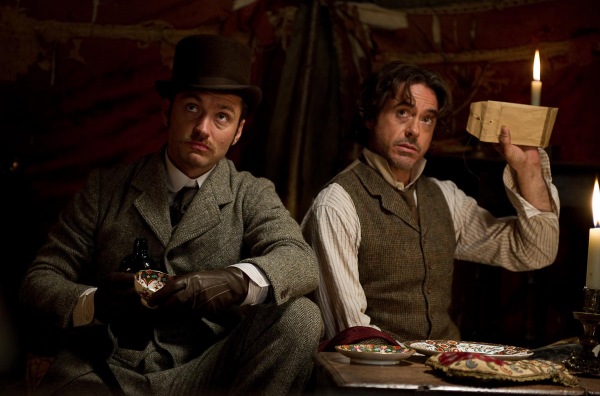
If you'd have told me only a couple of years ago that in 2009 I would be leaving a Guy Ritchie film having thoroughly enjoyed myself I would have had a hard time keeping a straight face. And yet Sherlock Holmes just worked, through a combination of dumb-but-fun plotting, Mark Strong doing his best Hammer Horror villain impression and the undeniable chemistry between Robert Downey Jr. and Jude Law. The film was a hit, and two years later we have the inevitable sequel. Strong is out, replaced by Jared Harris as Holmes' nemesis Professor Moriarty, who has an Evil Plan™ that manages to be both fiendishly convoluted and blindingly obvious at the same time; an impressive feat. It had something to do with starting a major world war so that he could profit from the arms trade (Wasn't that also his nefarious plan in The League of Extraordinary Gentlemen? The crafty bugger).
What follows is a thorough, two hour box ticking of the check list of globe-trotting action adventures: Assassins on a train? Check. A night at the opera? Check. Frenchman named Claude who exists purely for reasons of exposition? Check. Ludicrous and totally impractical mountaintop fortress lifted straight out of a Bond film? Check. But just as with it's predecessor, this is a film in which everyone involved seems have realised just how silly it all is, and decided to run with it anyway. Jared Harris makes a fantastic Blofeld to Mark Strong's Dracula, his scenes with Downey Jr. sparking the kind of chemistry that made the first film so enjoyable. Noomi Rapace too proves that she can successfully make the leap to English language films, it's just a shame that she's given something of a non-role. There's also a brilliantly enjoyable and revealing (in more than one sense of the word) cameo from Stephen Fry as Holmes' older brother Mycroft.
That's not to say that the film isn't without it's flaws. There's an overly long detour to Germany that's made even more grating by it's excessive use of slow motion. This was the moment at which I thought my old dislike of Ritchie's flashy, vacuous earlier films would rear it's head, the camera slowing to a crawl every time a character leaped through the air, loaded a gun or blew their nose. Fortunately it's not a lasting problem, and he does redeem himself slightly by using a surprisingly clever gag to turn Holmes and Moriarty's fist fight into mental one. But despite all these flaws and strengths, the reason that it all hangs together is still the relationship between Holmes and Watson, and the film works best when they are bickering and behaving like old women. In their dysfunctional relationship there is some surprisingly good comedy, and in the case of Watson's framing narration, something approaching genuine drama. It's not big and it's certainly not clever, but just as with the first film, it is extremely entertaining.
Saturday, 24 December 2011
Hugo (2011)

Martin Scorsese must have a lot to live up to. He is revered by critics, by his peers and by audiences, and you would be hard pressed to find any respectable 'Greatest Movies Ever' list that did not include at least one of his films. And so it comes as a surprise that not only has he made a family film, but that it seems to be the film that is closest to his own heart. Scorsese is a cinephile, and Hugo is a cinephile's delight. It's a heartfelt love letter to the mechanics and history of cinema, but one that works equally well as a family adventure film. Hugo Cabret (Asa Butterfield) is a young boy who lives in the walls of a Paris train station, where he has maintained the clocks and tried to repair an old automaton ever since his father died. After angering the elderly owner of a toy stall in the station (Ben Kingsley), Hugo and the stall owner's goddaughter Isabelle (Chloe Grace Moretz) slowly discover that this morose old man is none other than Georges Melies, the great cinematic pioneer. Together they decide to unlock the secret of his past and his connection to Hugo's automaton.
The film is visually stunning, with an almost herculean amount of effort put into the tiniest of details (look out for 'cameos' from Django Reinhardt, Salvador Dali and James Joyce in the station), but it's technical prowess never overshadows it's human elements. Asa Butterfield is disarmingly good as the titular Hugo, considering his young age, but it's Kingsley who really shines. He plays Melies with the tragic grandeur of a toppled ruler; a sad, crippled husk of a man unable to keep up with the changing world around him. It couldn't be further from the unashamedly creepy performance he gave in Shutter Island, Scorsese's last film. Also worthy of note is the pleasure in seeing Christopher Lee in a charmingly nice role as a kindly bookshop owner. Even Sacha Baron Cohen's antagonistic station inspector manages to be more than a two dimensional caricature; the metal leg brace that could have been merely a villainous gimmick becoming a delicate reminder of very real weakness and vulnerability.
The film is visually stunning, with an almost herculean amount of effort put into the tiniest of details (look out for 'cameos' from Django Reinhardt, Salvador Dali and James Joyce in the station), but it's technical prowess never overshadows it's human elements. Asa Butterfield is disarmingly good as the titular Hugo, considering his young age, but it's Kingsley who really shines. He plays Melies with the tragic grandeur of a toppled ruler; a sad, crippled husk of a man unable to keep up with the changing world around him. It couldn't be further from the unashamedly creepy performance he gave in Shutter Island, Scorsese's last film. Also worthy of note is the pleasure in seeing Christopher Lee in a charmingly nice role as a kindly bookshop owner. Even Sacha Baron Cohen's antagonistic station inspector manages to be more than a two dimensional caricature; the metal leg brace that could have been merely a villainous gimmick becoming a delicate reminder of very real weakness and vulnerability.
It is of course impossible to discuss the film without mentioning it's use of 3D. Several critics have put forward the most compelling theory as to why the 3D works in this case; that in a film about the mechanics of cinema, the 3D is drawing attention to itself as an alienation device. I have always found that 3D simply looks like lots of 2D images stacked on top of each other, but whereas this reduces the effect of most films, in Hugo it actually gave the film the look of an old Melies film. The film is so brilliantly made that it will work perfectly well in 2D, but even I have to begrudgingly admit that Scorsese has done a pretty good job with the third dimension. Hugo is the type of film that reminds you why you fell in love with cinema in the first place. It's a beautifully crafted valentine to cinema itself, and it's pure self indulgence on Scorsese's part, but his evident delight and wonder is infectious.
Saturday, 17 December 2011
Take Shelter (2011)

There is a moment in Take Shelter when the main character's wife finally snaps, screaming at him “Are you out of your mind!?”. It's a question the audience has been asking ever since they sat down. Curtis (Michael Shannon) is an an average, salt of the earth American, with an an average, blue collar job, an average home in an average white picket fence American town, and an average loving wife and an average young daughter. In fact the only decidedly unaverage thing about Curtis are his dreams of an impending storm of apocalyptic proportions. Night after night he is plagued by the belief that something catastrophic is coming, and that he must prepare to protect his family. He begins to obsessively stock pile food and renovate the storm shelter behind his house, using all his family's savings, while his wife Samantha (Jessica Chastain) becomes ever more concerned that he is succumbing to the paranoid schizophrenia that saw his mother institutionalised when he was just a boy.
At the heart of Take Shelter is the constant question of Curtis' sanity, and it's one to which director Jeff Nichols seems unwilling to give a straight answer. Despite everything we are told about his family's history of mental illness, and his own acceptance that he may be going insane, the entire film is saturated with an overwhelming sense of foreboding. Even in it's most quiet moments there is the sense that something cataclysmic is never far around the corner. In Curtis' obsessive paranoia there are echoes of Richard Dreyfuss in Close Encounters of the Third Kind, not least when his cosy family life begins to come apart at the seams. There are also the tiniest glimmers of a post 9/11 political subtext, with Curtis' growing paranoia over the nameless, faceless something coming to small town America, but this is so subtle it's barely there and the film works perfectly well without it.
Jessica Chastain gives a brilliantly restrained performance as his concerned wife, and in any other movie she would be the clear highlight; but this is Shannon's show. His performance veers wildly from understated intensity to out and out mania and it's a testament to his ability as an actor that he manages to bridge the gap so seamlessly. Curtis is a perfect example of the kind of roles that Shannon is now know for: a man circling the very edges of insanity, occasionally dipping his feet in before recoiling in horror, never demonstrated better than the scene in which he wildly berates his work colleagues for their lack of concern over his warnings, to the horror of his wife and confusion of his daughter. It's a heartbreaking moment, as any pretence of normality within his life comes crashing down, and he must endure the half scared, half pitying looks of his friends. The film's great triumph is in the emphasis placed on the fragility of his life over the portentous possibility of the storm, and it's an amazingly understated film, considering it deals with a potential apocalypse. I was so surprised by just how good it was that I spent ages racking my brain for the flaws I was sure I must have missed. If there is a problem, it lies in the running time, and at 121 minutes there is the tiniest sag in the middle of the film. This is a miniscule problem however, and it took me a long while of thinking to even come up with it. Five minutes probably could have been left out of the middle, but even as it is the film is an enigmatic, heartbreaking and compelling affair that I have no qualms about declaring a low key masterpiece.
Monday, 28 November 2011
We Need To Talk About Kevin (2011)
*Better late than never*
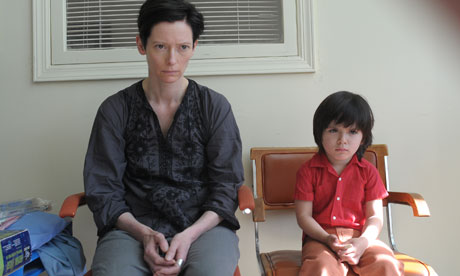
Misconception is a funny thing. Having heard great things about Lionel Shriver's novel We Need To Talk About Kevin, and excited at the prospect of an adaptation directed by Lynne Ramsay, I deliberately cut myself off from information about the about the book and the film. By the time I made my way to the cinema to see it, the only information I had been unable to escape was that it was about the mother of a boy who commits a Columbine style high school massacre (Everyone knows this right? Surely it can't be considered a spoiler.) But if I had been expecting a film thematically similar to Gus Van Zant's Elephant, I was mistaken. The specifics of Kevin's crime, while horrific, are totally irrelevant. The film is not about high school massacres, but about parenthood, and the relationship between Kevin and his mother Eva.
When we are first presented with Eva (Tilda Swinton), we are told nothing about her save for what we can glean from her haggard appearance, hermit lifestyle and the accusatory whispers that follow her everywhere. With a complex narrative structure that jumps backwards and forwards, we catch glimpses of her life before she became a mother and during Kevin's childhood. Although we begin to fill in the details, we are never entirely sure that what we are seeing is the full, objective story. From the moment he is born, Kevin seems to be evil incarnate, with a brooding glare to match Damien from The Omen. People who have criticised this less than subtle negative characterisation seem to have missed the point. We see Kevin as Eva sees him, and she is anything but a reliable narrator. However, the lack of any other perspectives means we never know how much of Kevin's seemingly evil behaviour is real, and how much is being exaggerated by Eva to mask her own failings as a mother. Coupled with the non-linear narrative, all this makes watching We Need To Talk About Kevin rather like trying to complete a jigsaw with only half the pieces and while blinfolded. It's an unsolvable puzzle of a movie, but Ramsay manages to stay one step ahead without ever patronising or condescending her audience.
The cast are incredible, with Swinton giving a surprisingly understated performance, which contrasts sharply with the unashamedly sinister Ezra Miller. John C Reilly also seems to have been overlooked by most for his role as Kevin's father Franklin, who refuses to believe that Kevin is anything other than a 'sweet little boy'. Ramsay however, is the star of the film; her stylised direction adding to the film's unsettling tone and making it seem like a much bigger budget movie than it actually is. All in all, it's a surprisingly low key affair that will probably be overlooked by the major awards who tend to favour flashier films, but it is an unnerving puzzle of a movie that refuses to give you any easy answers, and keeps raising questions long after it's credits have rolled.
Ken Russell: 1927-2011

Last year I woke up on the morning of my birthday only to hear the sad news that Leslie Nielsen, one of the greatest comic actors of his age, had died. This morning I once again woke on my birthday to tragic news; this time it was the death of Ken Russell. Losing a deadpan talent like Nielsen was one thing, but losing one of the most daring, original, brave and talented directors of all time was a tragedy. It wasn't just his death that was so sad (after all, he was 84 and had suffered multiple strokes), but that his extraordinary career seems to have been all but forgotten. The news report announcing his death that I later heard on the radio was shockingly brief, mentioning Women In Love but then tailing off as if Russell had simply retired after the success of that film.
But it shouldn't come as much of a surprise that Russell has faded from the consciousness of mainstream popular culture. After the underrated spy thriller The Billion Dollar Brain and the acclaimed Women In Love, his work became far less mainstream and awards friendly. He was always too provocative, too contemptuous of Hollywood, too unwilling to compromise to ever be thought of as anything other than an outsider. He ignored the whims of Hollywood, and as such they ignored him back and refused to recognise such a prodigious talent. His major breakthrough, Women In Love, caused shock and outrage, but even the normally prudish people behind the Academy Awards, who even decades later would rather reward the tepid Crash than Brokeback Mountain, felt compelled to shower it with nominations. After that however, his films became ever more divisive. The Devils, one of his most notorious works, was a shrieking, hysterical nightmare of violence, sex and religion based on a factual book by Aldous Huxley. While many derided it, with esteemed American critic Roger Ebert giving it a rare zero star rating, many other's felt it to be Russell's incendiary masterpiece. Most notable of it's defenders is Mark Kermode, who has long been among those arguing for a DVD release of the film's full X rated cut; calls that have recently been answered, with a DVD release planned for next March.
This barely begins to scratch the surface of the career, talent and appeal of Ken Russell, and I do not want to get into a detailed obituary. There are people who have written far better accounts of his life, and I do not have the time to mention every film he ever directed. Following The Devils, his work was often mired in controversy and usually far too idiosyncratic to ever be accepted by mainstream audiences. His last two commercial peaks came with 1975's gloriously overblown rock opera Tommy and 1980's haunting, psychedelic sci-fi Altered States, the only Hollywod film he ever made, and ironically one of his best works. Then there are the composer biopics, the horror films, the small TV works; Russell was nothing if not prolific. But his backing dried up and the scale of his films became smaller and smaller. His later films may have been pale shadows of his masterpieces, but the world was a better place for their existence.
Despite being abandoned by critics and audiences, Russell never broke his cardinal rule by making a dull film. His philosophy of “Wake 'em up” meant that even if his later films were horrifically flawed, they were always made even more fascinating for it. He proved that British cinema did not have to just be about kitchen sink dramas and Alfred Hitchcock; it could be flamboyant, provocative, daring and innovative. His drive to be different from everyone else meant that today he is mostly remembered as a director whose once promising talent deserted him after only a few films. Nothing could be further from the truth. Rather than going mainstream, Russell demanded that the mainstream go to him. Most people refused, and for them Russell is a distant memory. For those who rose to the challenge, and threw themselves head first into his work, he will always be remembered as a visionary, and one who would rather have given up completely than make a boring film. He will be deeply missed by many, including myself. If you haven't seen any of his films, you could a lot worse than treating yourself to them. You might love them, or you might hate them. But whatever your opinion, I'm sure he'd have been happy with it.
Subscribe to:
Posts (Atom)