Saturday, 25 February 2012

The Oscars 2012: Predictions

Hollywood's annual shameless back slapping is nearly with us again, so for several of the major categories, I've gone through and suggested who I think will win, who from the nominees I think should win and who should have been nominated. Feel free to come back on Monday morning and tell me how wrong I was:


Best Picture

Will win: The Artist. I just can't see it being anything else

Should win: Tricky. It's a fairly patchy category this year, and The Artist was a magnificent film, but my personal favourite was Hugo.

Should have been there: Drive, Tinker Tailor Soldier Spy and We Need To Talk About Kevin are the three that spring to mind. I'm sure that room could also have been made for Shame. Martha Marcy May Marlene was also a brilliant film, but it's a million miles removed from a typical Oscar nominee. If they got rid of the patronising foreign language category, A Separation would also have been a must, and The Skin I Live In would have been a brave choice. As it stands, the category is something of a stinker.


Best Director

Will win: Michel Hazanavicius

Should win: Although the film itself was an admirable but massively flawed mess, I'm going to go with Terrence Malick.

Should have been there: Lynne Ramsay and Nicolas Winding Refn. Would have been nice to see Pedro Almodovar and Tomas Alfredson in there too.


Best Actress

Will win: A hard one to call. Meryl Streep's momentum seems to finally be burning out, and Viola Davis is seeming ever more likely.

Should win: Again, it's hard to judge, as it's not a particularly strong category and I haven't seen Albert Nobbs yet, although I've heard that Glenn Close is very good. Anyone other than Meryl Streep, then.

Should have been there: Olivia Colman, for giving one of the best performances of any actor or actress all year. Leaving out Tilda Swinton was unforgivable too, and Elizabeth Olsen should have been in with a chance for Martha Marcy etc. Also, Charlize Theron was magnificently bitchy in Young Adult. Basically I'd replace all the nominees.


Best Actor

Will win: Dujardin seems to have confidently emerged as the frontrunner, and I'd say Clooney is snapping at his heels.

Should win: Gary Oldman. Next question

Should have been there: Fassbender for Shame is the first name that springs to mind. In what experts will soon be calling 'The Year of Ryan Gosling' it seems strange that he wasn't nominated for anything. I'd have gone with Drive. Michael Shannon too, for the excellent Take Shelter.


Best Supporting Actress

Will win: Octavia Spencer

Should win: Hmmm... Berenice Bejo, even though she should really be in the Best Actress category. It's not a great category to be honest. Although apparently Janet McTeer is very good.

Should have been there: Vanessa Redgrave for Coriolanus. Without a doubt. Also, Carey Mulligan for Shame. Jessica Chastain has also been nominated for the wrong film, she was much, much better in Take Shelter than in The Help. And although I hated the movie itself, Charlotte Gainsbourg was as terrific as ever in Melancholia. 
 

Best Supporting Actor

Will win: Christopher Plummer. Somebody could take it from him but I very much doubt it.

Should win: I want to say Max Von Sydow because he's one of my favourite actors, but I just can't justify picking him. Christopher Plummer was great, but I'm going to go with Kenneth Branagh, who was outstanding as Laurence Olivier.

Should have been there: Albert Brooks for Drive, and John Hawkes for Martha Marcy etc. Ezra Miller did the seemingly impossible by holding his own against Tilda Swinton, and about the half the cast of Tinker Tailor could safely fit into the list, particularly Benedict Cumberbatch.


Best Foreign Language Film

Will win: A Separation.

Should win: A Separation. There's a couple I haven't seen though, so I can't judge entirely.

Should have been there: The Skin I Live In, La Quottro Volte and Mysteries of Lisbon.


Best Original Screenplay

Will win: The Artist or Midnight in Paris

Should win: A Separation or Margin Call, but I'd be happy with The Artist or Midnight in Paris.


Best Adapted Screenplay

Will win: The Descendants or Tinker Tailor

Should win: Tinker Tailor

Should have been there: Coriolanus, for hacking down one of Shakepeare's most unwieldy plays into something lean and streamlined.


Best Original Score

Will win: The Artist. The music does have to carry most of the film, after all.

Should win: Tinker Tailor


And of course, Man or Muppet is quite rightly going to win Best Original Song.

Saturday, 11 February 2012

The Muppets (2012)


Did puppeteer Jim Henson know, all those years ago, when he first began to develop his surreal felt vaudeville troupe, just how successful, and how beloved they would become? That they would have fans in every walk of life, and from every corner of the globe? One of those fans is Jason Segel, and like any good fan he was distraught with the Muppets' fall from favour in the early 90s. Unlike most fans however, he has starred in several successful comedies, giving him the chance to put his heroes back on our screens. He also plays the part of Gary, a lifelong Muppets fan who, along with his girlfriend Mary (Amy Adams) and his Muppet obsessed and suspiciously felt like brother Walter, travels to LA to tour The Muppet studios and theatre. They find the studios derelict and about to be sold to evil oil tycoon Tex Richman (Chris Cooper, clearly having the time of his life) who secretly plans to demolish them and drill for oil. After tracking down the now lonely and reclusive Kermit in his mansion, they persuade him to track down and reform the old gang to put on one last show and save the theatre.

Above all else, the reason that the new Muppet film works so well is that it has clearly been made by people who love, know, and most importantly, understand The Muppets and their appeal. They have beautifully retained the anarchic, subversive and self referencing humour that shows little regard for logic, narrative conventions or even the laws of physics. Even the celebrity cameos never feel smug or forced, and the songs from Flight of the Conchords' Bret McKenzie are simply superb.

Just as with the Toy Story films however, the bravest decision has been to give the film a real emotional depth. There's a deep and melancholic sadness to much of the film, as the Muppets are forced to battle against the fact that the world has moved on, and that they are seen as relics of a bygone age. When Kermit roams his mansion, gazing longingly at the portraits of his former friends, it seems incredible just how much sadness and loss is conveyed by a green felt puppet. But one of the greatest triumphs of The Muppets has always been that we never see felt puppets. We see fully rounded characters, from the harried Kermit to the perennially optimistic Fozzie Bear, and every step of their journey seems as real as it would with live actors. When Kermit begins a rendition of the original Muppet Movie's 'Rainbow Connection' and is joined onstage by the rest of the Muppets for the song's finale, it's hard not to be moved (or in my case, not to cry). For this has always been the real brilliance of The Muppets: the certain knowledge that even when everything else is looking grey, a song, a dance and a badly cracked joke will always make the world that little bit better.

Thursday, 9 February 2012

Martha Marcy May Marlene (2012)


For someone with enough of an ego to believe that there may actually be people out there who read this blog, what I'm about to say may sound surprising. If you have already decided to see Martha Marcy May Marlene, please stop reading immediately. It's true that often films can be enjoyed more the less you know about them, but with MMMM, as I will call it from now on, it is ideal to enter the cinema with as little idea of possible as to what you are about to see. For anyone still reading, I'll try and give away as little of the plot as possible.

At the very beginning of the film, we see the titular character, played by Elizabeth Olsen (the one it's okay to like) running away from an unusual, but seemingly harmless rural commune and taking refuge with her estranged sister and brother-in-law. Needless to say, nothing is what it seems. Olsen is not the plucky heroine her flight would suggest, and the 'family' she has fled from, led by father figure Patrick (John Hawkes), is not the eccentric but oddly idyllic retreat it may have appeared. For anyone who knows anything about America in the 1960s, faint bells of recognition should be ringing at the idea of a close knit 'family' of misfits and the disenfranchised living in the wilderness, led by a manipulative 'father' and making night time excursions into people's houses.

Considering that this is Sean Durkin's debut, the directing is brilliantly assured and the performances are uniformly magnificent, particularly the fractured Olsen and the horribly sinister Hawkes, unbearably creepy without ever being overstated. Although it may never seem like it, MMMM is at it's core a horror movie, albeit a sparse, enigmatic and intelligent one. Rather than offer the puerile gross outs of Hostel or the cheap bump in the night shtick of Paranormal Activity, MMMM succeeds where so many horrors fail: it slowly creeps under your skin and then stays there long after the credits have rolled.

I hope this has been unhelpful. Just trust me, and see it.

Thursday, 26 January 2012

Coriolanus (2012)


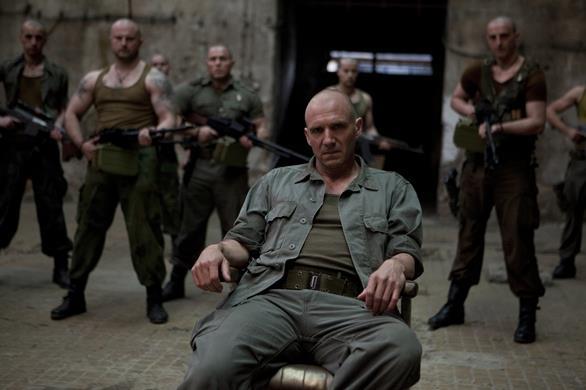
As Ralph Fiennes and Gerard Butler, covered in dirt, sweat and blood, grapple violently on the floor, in a surprisingly similar manner to Alan Bates and Oliver Reed wrestling nude in Women In Love, it should be clear that this is not your standard Shakespeare adaptation. This is the Bard stripped down to barest essentials and shifted to what looks like the modern day Balkans. Coriolanus, about the titular Roman general who is banished and swears revenge against his own people, is renowned as one of Shakespeare's densest and most convoluted plays, and Fiennes deserves praise for not only clarifying the narrative but bringing to the fore themes that make it a surprisingly contemporary film. It's obvious questions about class war, democracy and the nation state make it a fitting film to come at the end of a year of rolling news, increasingly violent protest and the Arab Spring. Even a cameo from Jon Snow, speaking full Shakespearean verse, feels un-gimmicky and strangely appropriate.

Fiennes does a perfectly adequate job behind the camera, making the explosive battle scenes unbearably intense, but he does an exemplary job in front of it. Acting with his entire body, he turns a pitiless, fascistic brute into a scarily charismatic figure; his eyes alone carrying a singular determination that is almost terrifying. Coriolanus is not an easy figure to engage with and Fiennes makes no attempt to soften his disdain and contempt for the masses. He's helped by some stunning support from Jessica Chastain (continuing her quest to be in every single film ever released from now on), Brian Cox and James Nesbitt, and even Gerard Butler turns in a fine performance as Coriolanus' sworn enemy. But casting a shadow over the film is the presence of Vanessa Redgrave as Coriolanus' manipulative mother. She runs away with every single scene she is in and reminds those who needed reminding that when she is on form, no actress on Earth can touch her. It's a towering performance that in any sane world would have seen her name in every single Best Supporting Actress list; clearly this is not a sane world. Her performance, contrasted with Chastain's, adds an interesting female element to the film; of the two major female characters in this predominantly male world of war and politics, one is meek and timid and the other manipulative and matriarchal. Like with many boxing movies, Coriolanus shows how in an overly aggressive, male dominated world such as that of the film, women are pushed to the sidelines, where they are forced to either look on in horror or egg on those in the ring for their own benefit. Combined with it's questions about politicians and the masses, and the corrupting nature of power, Coriolanus is a raw, brutal and primal film that unceremoniously but very effectively dumps Shakespeare right into the middle of the new decade.

Saturday, 31 December 2011

Sherlock Holmes: A Game of Shadows (2011)


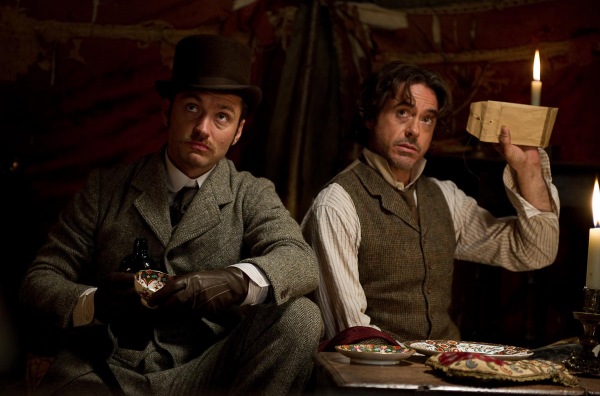
If you'd have told me only a couple of years ago that in 2009 I would be leaving a Guy Ritchie film having thoroughly enjoyed myself I would have had a hard time keeping a straight face. And yet Sherlock Holmes just worked, through a combination of dumb-but-fun plotting, Mark Strong doing his best Hammer Horror villain impression and the undeniable chemistry between Robert Downey Jr. and Jude Law. The film was a hit, and two years later we have the inevitable sequel. Strong is out, replaced by Jared Harris as Holmes' nemesis Professor Moriarty, who has an Evil Plan™ that manages to be both fiendishly convoluted and blindingly obvious at the same time; an impressive feat. It had something to do with starting a major world war so that he could profit from the arms trade (Wasn't that also his nefarious plan in The League of Extraordinary Gentlemen? The crafty bugger).

What follows is a thorough, two hour box ticking of the check list of globe-trotting action adventures: Assassins on a train? Check. A night at the opera? Check. Frenchman named Claude who exists purely for reasons of exposition? Check. Ludicrous and totally impractical mountaintop fortress lifted straight out of a Bond film? Check. But just as with it's predecessor, this is a film in which everyone involved seems have realised just how silly it all is, and decided to run with it anyway. Jared Harris makes a fantastic Blofeld to Mark Strong's Dracula, his scenes with Downey Jr. sparking the kind of chemistry that made the first film so enjoyable. Noomi Rapace too proves that she can successfully make the leap to English language films, it's just a shame that she's given something of a non-role. There's also a brilliantly enjoyable and revealing (in more than one sense of the word) cameo from Stephen Fry as Holmes' older brother Mycroft.

That's not to say that the film isn't without it's flaws. There's an overly long detour to Germany that's made even more grating by it's excessive use of slow motion. This was the moment at which I thought my old dislike of Ritchie's flashy, vacuous earlier films would rear it's head, the camera slowing to a crawl every time a character leaped through the air, loaded a gun or blew their nose. Fortunately it's not a lasting problem, and he does redeem himself slightly by using a surprisingly clever gag to turn Holmes and Moriarty's fist fight into mental one. But despite all these flaws and strengths, the reason that it all hangs together is still the relationship between Holmes and Watson, and the film works best when they are bickering and behaving like old women. In their dysfunctional relationship there is some surprisingly good comedy, and in the case of Watson's framing narration, something approaching genuine drama. It's not big and it's certainly not clever, but just as with the first film, it is extremely entertaining.

Saturday, 24 December 2011

Hugo (2011)


Martin Scorsese must have a lot to live up to. He is revered by critics, by his peers and by audiences, and you would be hard pressed to find any respectable 'Greatest Movies Ever' list that did not include at least one of his films. And so it comes as a surprise that not only has he made a family film, but that it seems to be the film that is closest to his own heart. Scorsese is a cinephile, and Hugo is a cinephile's delight. It's a heartfelt love letter to the mechanics and history of cinema, but one that works equally well as a family adventure film. Hugo Cabret (Asa Butterfield) is a young boy who lives in the walls of a Paris train station, where he has maintained the clocks and tried to repair an old automaton ever since his father died. After angering the elderly owner of a toy stall in the station (Ben Kingsley), Hugo and the stall owner's goddaughter Isabelle (Chloe Grace Moretz) slowly discover that this morose old man is none other than Georges Melies, the great cinematic pioneer. Together they decide to unlock the secret of his past and his connection to Hugo's automaton.

The film is visually stunning, with an almost herculean amount of effort put into the tiniest of details (look out for 'cameos' from Django Reinhardt, Salvador Dali and James Joyce in the station), but it's technical prowess never overshadows it's human elements. Asa Butterfield is disarmingly good as the titular Hugo, considering his young age, but it's Kingsley who really shines. He plays Melies with the tragic grandeur of a toppled ruler; a sad, crippled husk of a man unable to keep up with the changing world around him. It couldn't be further from the unashamedly creepy performance he gave in Shutter Island, Scorsese's last film. Also worthy of note is the pleasure in seeing Christopher Lee in a charmingly nice role as a kindly bookshop owner. Even Sacha Baron Cohen's antagonistic station inspector manages to be more than a two dimensional caricature; the metal leg brace that could have been merely a villainous gimmick becoming a delicate reminder of very real weakness and vulnerability.

It is of course impossible to discuss the film without mentioning it's use of 3D.  Several critics have put forward the most compelling theory as to why the 3D works in this case; that in a film about the mechanics of cinema, the 3D is drawing attention to itself as an alienation device. I have always found that 3D simply looks like lots of 2D images stacked on top of each other, but whereas this reduces the effect of most films, in Hugo it actually gave the film the look of an old Melies film. The film is so brilliantly made that it will work perfectly well in 2D, but even I have to begrudgingly admit that Scorsese has done a pretty good job with the third dimension. Hugo is the type of film that reminds you why you fell in love with cinema in the first place. It's a beautifully crafted valentine to cinema itself, and it's pure self indulgence on Scorsese's part, but his evident delight and wonder is infectious.

Saturday, 17 December 2011

Take Shelter (2011)


There is a moment in Take Shelter when the main character's wife finally snaps, screaming at him “Are you out of your mind!?”. It's a question the audience has been asking ever since they sat down. Curtis (Michael Shannon) is an an average, salt of the earth American, with an an average, blue collar job, an average home in an average white picket fence American town, and an average loving wife and an average young daughter. In fact the only decidedly unaverage thing about Curtis are his dreams of an impending storm of apocalyptic proportions. Night after night he is plagued by the belief that something catastrophic is coming, and that he must prepare to protect his family. He begins to obsessively stock pile food and renovate the storm shelter behind his house, using all his family's savings, while his wife Samantha (Jessica Chastain) becomes ever more concerned that he is succumbing to the paranoid schizophrenia that saw his mother institutionalised when he was just a boy.

At the heart of Take Shelter is the constant question of Curtis' sanity, and it's one to which director Jeff Nichols seems unwilling to give a straight answer. Despite everything we are told about his family's history of mental illness, and his own acceptance that he may be going insane, the entire film is saturated with an overwhelming sense of foreboding. Even in it's most quiet moments there is the sense that something cataclysmic is never far around the corner. In Curtis' obsessive paranoia there are echoes of Richard Dreyfuss in Close Encounters of the Third Kind, not least when his cosy family life begins to come apart at the seams. There are also the tiniest glimmers of a post 9/11 political subtext, with Curtis' growing paranoia over the nameless, faceless something coming to small town America, but this is so subtle it's barely there and the film works perfectly well without it.

Jessica Chastain gives a brilliantly restrained performance as his concerned wife, and in any other movie she would be the clear highlight; but this is Shannon's show. His performance veers wildly from understated intensity to out and out mania and it's a testament to his ability as an actor that he manages to bridge the gap so seamlessly. Curtis is a perfect example of the kind of roles that Shannon is now know for: a man circling the very edges of insanity, occasionally dipping his feet in before recoiling in horror, never demonstrated better than the scene in which he wildly berates his work colleagues for their lack of concern over his warnings, to the horror of his wife and confusion of his daughter. It's a heartbreaking moment, as any pretence of normality within his life comes crashing down, and he must endure the half scared, half pitying looks of his friends. The film's great triumph is in the emphasis placed on the fragility of his life over the portentous possibility of the storm, and it's an amazingly understated film, considering it deals with a potential apocalypse. I was so surprised by just how good it was that I spent ages racking my brain for the flaws I was sure I must have missed. If there is a problem, it lies in the running time, and at 121 minutes there is the tiniest sag in the middle of the film. This is a miniscule problem however, and it took me a long while of thinking to even come up with it. Five minutes probably could have been left out of the middle, but even as it is the film is an enigmatic, heartbreaking and compelling affair that I have no qualms about declaring a low key masterpiece.

Monday, 28 November 2011

We Need To Talk About Kevin (2011)


 *Better late than never*

Misconception is a funny thing. Having heard great things about Lionel Shriver's novel We Need To Talk About Kevin, and excited at the prospect of an adaptation directed by Lynne Ramsay, I deliberately cut myself off from information about the about the book and the film. By the time I made my way to the cinema to see it, the only information I had been unable to escape was that it was about the mother of a boy who commits a Columbine style high school massacre (Everyone knows this right? Surely it can't be considered a spoiler.) But if I had been expecting a film thematically similar to Gus Van Zant's Elephant, I was mistaken. The specifics of Kevin's crime, while horrific, are totally irrelevant. The film is not about high school massacres, but about parenthood, and the relationship between Kevin and his mother Eva.

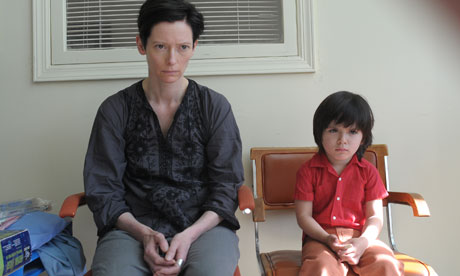
When we are first presented with Eva (Tilda Swinton), we are told nothing about her save for what we can glean from her haggard appearance, hermit lifestyle and the accusatory whispers that follow her everywhere. With a complex narrative structure that jumps backwards and forwards, we catch glimpses of her life before she became a mother and during Kevin's childhood. Although we begin to fill in the details, we are never entirely sure that what we are seeing is the full, objective story. From the moment he is born, Kevin seems to be evil incarnate, with a brooding glare to match Damien from The Omen. People who have criticised this less than subtle negative characterisation seem to have missed the point. We see Kevin as Eva sees him, and she is anything but a reliable narrator. However, the lack of any other perspectives means we never know how much of Kevin's seemingly evil behaviour is real, and how much is being exaggerated by Eva to mask her own failings as a mother. Coupled with the non-linear narrative, all this makes watching We Need To Talk About Kevin rather like trying to complete a jigsaw with only half the pieces and while blinfolded. It's an unsolvable puzzle of a movie, but Ramsay manages to stay one step ahead without ever patronising or condescending her audience.

The cast are incredible, with Swinton giving a surprisingly understated performance, which contrasts sharply with the unashamedly sinister Ezra Miller. John C Reilly also seems to have been overlooked by most for his role as Kevin's father Franklin, who refuses to believe that Kevin is anything other than a 'sweet little boy'. Ramsay however, is the star of the film; her stylised direction adding to the film's unsettling tone and making it seem like a much bigger budget movie than it actually is. All in all, it's a surprisingly low key affair that will probably be overlooked by the major awards who tend to favour flashier films, but it is an unnerving puzzle of a movie that refuses to give you any easy answers, and keeps raising questions long after it's credits have rolled.

Ken Russell: 1927-2011


Last year I woke up on the morning of my birthday only to hear the sad news that Leslie Nielsen, one of the greatest comic actors of his age, had died. This morning I once again woke on my birthday to tragic news; this time it was the death of Ken Russell. Losing a deadpan talent like Nielsen was one thing, but losing one of the most daring, original, brave and talented directors of all time was a tragedy. It wasn't just his death that was so sad (after all, he was 84 and had suffered multiple strokes), but that his extraordinary career seems to have been all but forgotten. The news report announcing his death that I later heard on the radio was shockingly brief, mentioning Women In Love but then tailing off as if Russell had simply retired after the success of that film.

But it shouldn't come as much of a surprise that Russell has faded from the consciousness of mainstream popular culture. After the underrated spy thriller The Billion Dollar Brain and the acclaimed Women In Love, his work became far less mainstream and awards friendly. He was always too provocative, too contemptuous of Hollywood, too unwilling to compromise to ever be thought of as anything other than an outsider. He ignored the whims of Hollywood, and as such they ignored him back and refused to recognise such a prodigious talent. His major breakthrough, Women In Love, caused shock and outrage, but even the normally prudish people behind the Academy Awards, who even decades later would rather reward the tepid Crash than Brokeback Mountain, felt compelled to shower it with nominations. After that however, his films became ever more divisive. The Devils, one of his most notorious works, was a shrieking, hysterical nightmare of violence, sex and religion based on a factual book by Aldous Huxley. While many derided it, with esteemed American critic Roger Ebert giving it a rare zero star rating, many other's felt it to be Russell's incendiary masterpiece. Most notable of it's defenders is Mark Kermode, who has long been among those arguing for a DVD release of the film's full X rated cut; calls that have recently been answered, with a DVD release planned for next March.

This barely begins to scratch the surface of the career, talent and appeal of Ken Russell, and I do not want to get into a detailed obituary. There are people who have written far better accounts of his life, and I do not have the time to mention every film he ever directed. Following The Devils, his work was often mired in controversy and usually far too idiosyncratic to ever be accepted by mainstream audiences. His last two commercial peaks came with 1975's gloriously overblown rock opera Tommy and 1980's haunting, psychedelic sci-fi Altered States, the only Hollywod film he ever made, and ironically one of his best works. Then there are the composer biopics, the horror films, the small TV works; Russell was nothing if not prolific. But his backing dried up and the scale of his films became smaller and smaller. His later films may have been pale shadows of his masterpieces, but the world was a better place for their existence.

Despite being abandoned by critics and audiences, Russell never broke his cardinal rule by making a dull film. His philosophy of “Wake 'em up” meant that even if his later films were horrifically flawed, they were always made even more fascinating for it. He proved that British cinema did not have to just be about kitchen sink dramas and Alfred Hitchcock; it could be flamboyant, provocative, daring and innovative. His drive to be different from everyone else meant that today he is mostly remembered as a director whose once promising talent deserted him after only a few films. Nothing could be further from the truth. Rather than going mainstream, Russell demanded that the mainstream go to him. Most people refused, and for them Russell is a distant memory. For those who rose to the challenge, and threw themselves head first into his work, he will always be remembered as a visionary, and one who would rather have given up completely than make a boring film. He will be deeply missed by many, including myself. If you haven't seen any of his films, you could a lot worse than treating yourself to them. You might love them, or you might hate them. But whatever your opinion, I'm sure he'd have been happy with it.